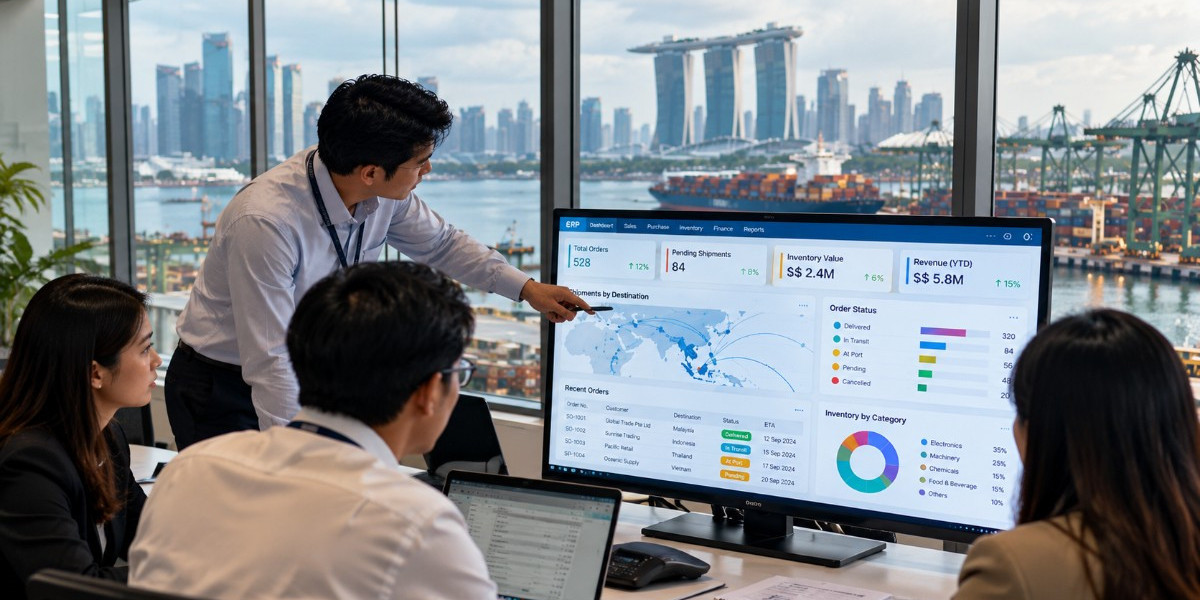

Singapore has never relied on size to compete. With no natural resources and a small domestic market, the country built its economy on being efficient, connected and trusted. Its total trade is several times the size of its GDP, and its port and airport rank among the busiest in the world. Behind that reputation sits a less visible layer of technology that keeps goods, money and information moving accurately. For a growing number of companies, that layer is enterprise resource planning, or ERP.
What ERP Means for a Trade-Driven Economy
ERP is a set of integrated software modules that bring finance, procurement, inventory, sales, human resources and production into a single system. Instead of keeping separate spreadsheets for each department, a business works from one shared record. When a purchase order is approved, the inventory count, the supplier ledger and the cash flow forecast update together.
In a country where a single shipment may cross three jurisdictions, involve several currencies and require multiple permits, this kind of shared visibility is a practical necessity. Companies that handle trade documentation, customs declarations and cross-border payments manually tend to face delays, duplicate entries and costly errors. An ERP system reduces these problems by keeping every record tied to the same source of truth.
Why Singapore Is a Natural Fit
Several features of the local environment make ERP adoption more common here than in many comparable markets.
A strong digital policy backdrop. The Smart Nation initiative, the work of the Infocomm Media Development Authority (IMDA) and Enterprise Singapore have all encouraged firms to digitalise. Schemes such as the Productivity Solutions Grant and the Enterprise Development Grant have helped smaller companies offset part of the cost of adopting pre-approved digital solutions or funding larger transformation projects.
National e-invoicing. InvoiceNow, Singapore’s e-invoicing network built on the Peppol standard, allows businesses to send and receive invoices directly between accounting or ERP systems. Companies with integrated finance modules can exchange structured invoice data without retyping it, which shortens payment cycles and lowers reconciliation work.
Regulatory discipline. GST filing, ACRA reporting requirements and the Personal Data Protection Act (PDPA) all reward companies that keep clean, traceable records. ERP platforms support audit trails, role-based access and consistent reporting, which make compliance less of a scramble at year end.
A competitive, high-cost business environment. Rents and wages are high, so productivity gains matter. Automating repetitive tasks lets a small team handle more volume without a matching rise in headcount.
Business Automation Beyond the Back Office
The most visible benefit of ERP is business automation. Routine tasks such as generating invoices, matching purchase orders to receipts, calculating payroll and triggering reorder alerts can run with little manual input. This frees finance and operations staff for analysis and decision-making instead of data entry.
Take a mid-sized electronics distributor in Singapore that supplies components across Southeast Asia. Without automation, its staff may spend hours each week reconciling stock levels across a warehouse in Tuas and a regional partner in Johor. With an integrated system, stock movements, customer orders and shipping documents flow through one workflow. Managers see real-time inventory, and sales teams can confirm delivery dates with more confidence.
Automation also improves data quality. When information is entered once and reused across departments, there are fewer opportunities for transcription errors, and reports become more reliable. That reliability matters to banks, investors and trading partners who increasingly expect transparent financial data.
ERP Development and Customisation
Off-the-shelf packages work well for many firms, but not all. A food manufacturer dealing with halal certification and batch traceability has different needs from a professional services firm that bills by the hour. This is where ERP development becomes important. Custom modules, tailored reports and workflow adjustments let a system reflect how a business actually operates rather than forcing staff to adapt to rigid software.
Good development work usually starts with process mapping, not code. Teams document how orders, approvals and payments currently move, identify bottlenecks, and decide which steps should be standardised and which genuinely need a custom approach. Over-customising can make future upgrades expensive, so experienced practitioners tend to keep the core system close to standard and add extensions only where they create clear value.
The Role of ERP Integration for Business
Few companies run on a single platform. Most also use e-commerce storefronts, customer relationship management tools, warehouse scanners, banking portals and government interfaces. ERP integration for business connects these systems so that data moves between them automatically.
In Singapore, common integration points include payment gateways, logistics providers, customs and trade documentation platforms such as TradeNet, and e-invoicing networks. A retailer, for example, can link its online store to its ERP so that every web order updates stock, triggers fulfilment and posts revenue to the ledger without manual handling. Application programming interfaces (APIs) and middleware make this practical, although each connection needs careful testing and clear ownership once it goes live.
What Good ERP Implementation Services Involve
Organisations looking for ERP implementation services in Singapore often discover that the software itself is only part of the project. Success depends heavily on planning, data preparation and people.
A typical engagement covers several stages: requirements gathering, system selection, configuration, data migration, testing, user training and post-launch support. Data migration is frequently underestimated. Old customer lists, item masters and supplier records often contain duplicates and inconsistencies that should be cleaned before moving to a new platform.
Change management is equally important. Employees accustomed to spreadsheets may resist a new system if they do not understand its benefits. Phased rollouts, hands-on training and visible support from senior management tend to produce better adoption than a sudden switch. Companies should also weigh deployment options, whether cloud-based, on-premises, or hybrid, in light of cost, security requirements and the size of their IT team. Cloud ERP has grown popular among small and medium enterprises because it reduces upfront infrastructure spending and simplifies updates.
Economic Impact at the National Level
Small and medium enterprises make up the vast majority of businesses in Singapore, employ a large share of the workforce and contribute a significant portion of GDP. When these firms become more efficient, the effect compounds across supply chains. A better-run distributor serves its customers faster, a better-managed manufacturer wastes less material, and a better-organised exporter handles documentation with fewer delays.
Over time, this raises productivity, supports Singapore’s position as a regional trading and logistics hub, and strengthens its appeal to multinational companies that expect partners to operate with modern systems. ERP is not the only driver of this shift, but it is one of the foundations on which other technologies such as analytics, artificial intelligence and supply chain visibility tools are built.
Challenges to Keep in Mind
ERP projects can fail when objectives are vague, budgets are unrealistic or internal processes are poorly understood. Cybersecurity is another concern, since centralised data is valuable and must be protected under PDPA obligations. Businesses should also plan for ongoing costs, including licences, maintenance and periodic training, rather than treating implementation as a one-time expense.
Looking Ahead
As Singapore continues to push for digital trade, cleaner reporting and smarter logistics, ERP is likely to remain central to how local businesses operate and grow. Companies that treat it as a long-term operating foundation, rather than a short-term software purchase, are better placed to adapt to new regulations, new markets and new customer expectations.